Marvell’s $115 billion for laser maker Lumentum works out to 23 times its revenue run rate
Priced at Marvell’s 28 October close, the deal comes to 18 times Lumentum’s annualized December guidance, just under Marvell’s own revenue multiple that day.
A fixed ratio puts a dollar price on one day
In Marvell’s own drawing of an optical module, the electronics are Marvell’s and every laser is Lumentum’s.1 On 2 November the two companies announced that Marvell will buy Lumentum for 4.500 Marvell shares per Lumentum share, an implied enterprise value of $115 billion.2 Neither company states a multiple. Divided by Lumentum’s September quarter of $1.263 billion annualized, its run rate, the price is 22.8 times revenue. It is 14.4 times if Lumentum reaches the $8 billion a year its March investor deck sets as a target.34
The $115 billion is a value at Marvell’s 28 October closing price, the last trading day before market speculation about the deal began.21 The ratio is fixed, so the dollar price moves with Marvell’s stock until the close, expected in the first half of 2028.
Co-packaged optics leaves Lumentum the light source
Marvell block Lumentum block not colored on the slide
Slide 13 splits each module into electronics and photonics. The electronics are Marvell’s: the DSP, which turns the host’s SerDes lanes into the signal that drives the laser and back, the drivers that carry that signal to the laser, and the TIAs that amplify the photodiode’s current. The laser and photodiode are Lumentum’s. Marvell’s 10-K uses the word laser only in “laser drivers.”5
Co-packaging moves the boundary. A pluggable module’s EML is one Lumentum part that both makes the light and modulates it. In co-packaged optics those are two devices: a continuous-wave laser makes steady light, and a modulator on the silicon-photonics chip imposes the data.6 Slide 14 draws that photonic chip as Marvell’s and puts Lumentum’s laser outside the package, in an external pluggable feeding several photonic chips.1 What passes from a Lumentum part to a Marvell part is then unmodulated light on a fiber.
Lumentum’s chief executive, Michael Hurlston, said: “we supply our lasers to almost all of our competitors.”7 Lumentum reports Components, which include laser chips, at $2,005.6 million of FY2026’s $3,014.0 million. Systems, which are modules, optical circuit switches and industrial lasers, were $1,008.4 million. The switches, which sit outside the link above, contributed more than $90.0 million.8
Five revenue figures give five multiples
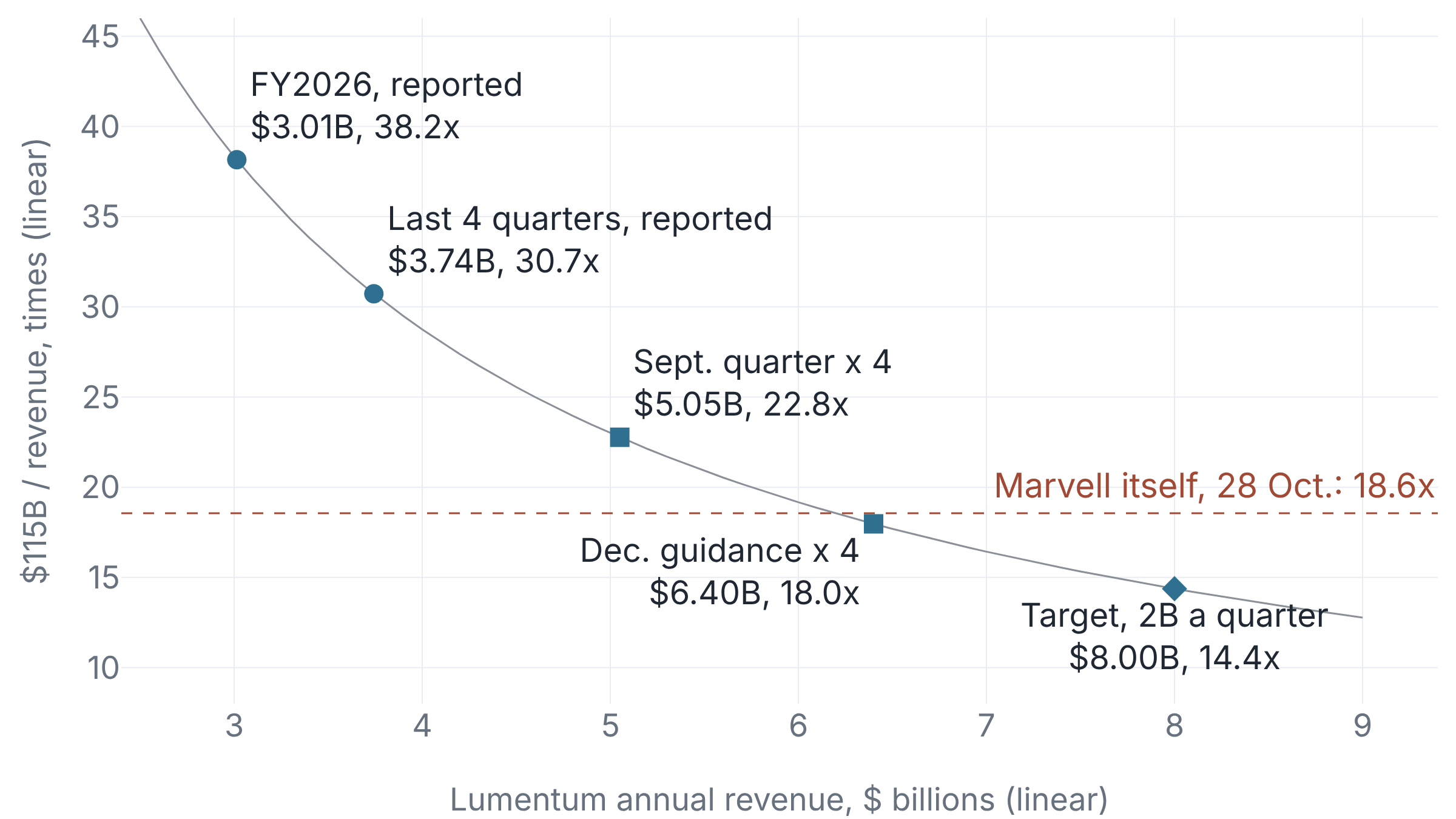
September revenue was 136.5% above the year before and 25.5% above June.3 Lumentum guides December to $1.575 to $1.625 billion, 26.7% above September at the midpoint.
Marvell’s own enterprise value at its 28 October price is about $233.9 billion, 18.6 times its guided quarter annualized, $12.6 billion.1 That is the paper’s reconstruction from the Merger Agreement’s share counts and 1 August net debt. It leaves out in-the-money warrants, which understates it.910 The $115 billion comes down to that 18.6 times at $6.2 billion of Lumentum revenue, less than the $6.4 billion its December guidance annualizes to.
Lumentum’s employee FAQ values the deal at “approximately $100 billion.”11 Both figures can be rebuilt from the Merger Agreement at $1,132 a share. In the paper’s reconstruction, 90.68 million common shares come to $102.7 billion. Counting preferred stock, options, stock awards and the shares issuable on convertible notes gives 103.29 million shares and $116.9 billion, or $114.9 billion after $1.98 billion of cash.93 The filings do not say what the FAQ counts.
The $550 billion market is two forecasts and a $60 billion increment
The first two sum to $490 billion, and the deck shows $550 billion.1 Marvell’s $400 billion includes $235 billion of custom silicon and $65 billion of interconnect.12 Lumentum’s $90 billion-plus is an all-vendor industry revenue forecast built on LightCounting and 650 Group data.4 Marvell’s chief executive, Matt Murphy, put the increment at $60 billion, most of it interconnect and mostly scale-up.7 A transceiver’s revenue includes its DSP, which Marvell counts inside its own $65 billion. Some dollars may therefore sit in both forecasts. That is the paper’s inference, and no document sizes it.
The $115 billion is at most 1.28 times that whole-industry forecast. Vivek Arya of Bank of America Securities asked on the call how Marvell knew it was not buying “a company at the peak of its shortage environment.” Murphy answered that “there are supply shortages today across the industry,” Marvell’s included, and that Marvell’s XPUs, switches and DSPs at the same hyperscalers show him “the design wins are real.”7 He gave no supply figure.
Lumentum’s filings show the shortage. Its 10-K says demand is “outpacing our current supply,” and its March deck lists a backlog of more than two years for EML and CW laser chips. Two unnamed customers were 26.6% and 15.0% of FY2026 revenue.84
At December guidance the price already sits just under Marvell’s own multiple. Lumentum’s $8 billion target needs a $2 billion quarter after that, one more step of about September’s 25.5%, and Lumentum has guided only as far as December.
Sources
- Marvell · Marvell and Lumentum combine, investor presentation, 2 November 2026
- Marvell and Lumentum · Joint press release, Form 8-K Exhibit 99.1, 2 November 2026
- Lumentum · Q1 fiscal 2027 earnings release, 2 November 2026
- Lumentum · OFC investor briefing, 17 March 2026
- Marvell · Form 10-K for the fiscal year ended 31 January 2026
- Lumentum · How Optical Connectivity Is Evolving in Scale-Out AI Networks, 25 August 2026
- Marvell and Lumentum · Joint call transcript, Rule 425 filing, 2 November 2026
- Lumentum · Form 10-K for the fiscal year ended 27 June 2026
- Lumentum · Form 8-K with the Agreement and Plan of Merger, 2 November 2026
- Marvell · Form 10-Q for the quarter ended 1 August 2026
- Lumentum · Employee email and FAQ, Rule 425 filing, 2 November 2026
- Marvell · Investor Day deck, 6 October 2026