No trial behind the “first tooth” rule enrolled a child younger than one
The varnish and supplement guidance rest on the same trials that stopped at age one, where the drops still prescribed to a six-month-old in low-fluoride water now carry an October 2025 FDA warning.
Two decisions arrive with the first tooth
A child born in February 2026 turns six months old this August, the age a first tooth usually erupts, and two fluoride decisions turn live at once. The American Academy of Pediatrics says fluoride toothpaste should begin “with the eruption of the first tooth,” in an amount “limited to a smear or grain of rice size” for a child under three.1 The US Preventive Services Task Force separately recommends that a clinician “prescribe oral fluoride supplementation starting at age 6 months” for a child whose household water is “deficient in fluoride.” It defines that as below 0.6 parts fluoride per million (ppm F).2 Both bodies name six months specifically.
Neither recommendation is wrong. Both rest on real trial evidence for fluoride’s effect on tooth decay, and on a real, measurable relationship between fluoride and dental fluorosis. Fluorosis is faint white or brown mottling on the permanent teeth. It can follow too much fluoride exposure while those teeth are still forming under the gum. But neither trial base includes a child quite this young, and on the supplement question, a federal drug regulator has just broken with the pediatric schedule outright.
The trials stop at age one; the guidance starts at six months
The toothpaste decision rests on the stronger evidence. Walsh et al.’s 2019 Cochrane review pooled 96 trials and 67,335 randomized participants comparing fluoride toothpaste against non-fluoride toothpaste, and different concentrations against each other.3 Its clearest result concerns children and adolescents with immature permanent teeth. There, 1000-to-1250-ppm fluoride toothpaste cut tooth decay compared with no fluoride, a standardized mean difference of −0.28 across 55 studies (95% CI −0.32 to −0.25). A more negative number means less decay, and the confidence interval is the range the true effect most likely falls in. Cochrane rated it high-certainty evidence, the single most robust finding in the review.3 Going stronger helped a little more. 1450-to-1500-ppm toothpaste showed a larger effect against no fluoride (SMD −0.36), and beat 1000-to-1250 ppm head-to-head by a smaller margin (SMD −0.08, moderate certainty).3 The curve is real, but the added benefit past 1000-1250 ppm is small. In primary teeth specifically, one trial of 998 children found that 1500 ppm toothpaste cut decayed primary-tooth surfaces by a mean of 1.86 over 24 months compared with no fluoride, moderate-certainty evidence.3 The review’s own authors summed up the tradeoff plainly: toothpaste concentration for young children “should be balanced against the risk of fluorosis.”3
Every one of those numbers comes from trials that enrolled toddlers and older children, not infants. Walsh’s own summary table describes its primary-dentition population as “young children between 1 and 6 years of age at the start of the study.”3 Marinho et al.’s 2013 Cochrane review of fluoride varnish, the other main tool in early caries prevention, pooled 22 trials whose participants “ranged from 1 to 15 years.” Only eight of those trials included any child from one to five.4 No trial in either review enrolled a participant younger than one. The American Dental Association’s own toothpaste guideline gives the identical amount rule as the AAP for children under three, “no more than a smear or the size of a grain of rice,” brushed twice daily and supervised.5 All three bodies recommending fluoride at six months, the AAP, the ADA and the USPSTF, are extrapolating from evidence that starts at one. The AAP’s own 2014 clinical report traces its toothpaste rationale to a review of that same Cochrane literature, not to any infant-specific trial.1
The fluorosis risk that holds up is about strength, not starting age
Fluorosis develops only while a permanent tooth’s enamel is still forming under the gum, a window that closes by around age eight. The permanent upper front teeth, the ones fluorosis affects most visibly, are most vulnerable between about 15 and 30 months of age.1 Severe fluorosis, brown mottling with pitted enamel, is uncommon: fewer than 2% of children in the trials the USPSTF reviewed developed it. Four trials covering 4,141 children found no difference in fluorosis risk between fluoride varnish and control.2 Milder fluorosis, faint white striations most people never notice, is common in the general population. A national health survey found some degree of fluorosis in 23% of Americans aged 6 to 49. The rate is highest among 12-to-15-year-olds, 40.6%, and it has climbed there too: the same age band ran 22.6% in a 1986-87 survey, before reaching 40.7% by 1999-2004.6 That is a population baseline, not a rate any toothpaste or supplement trial measured directly.
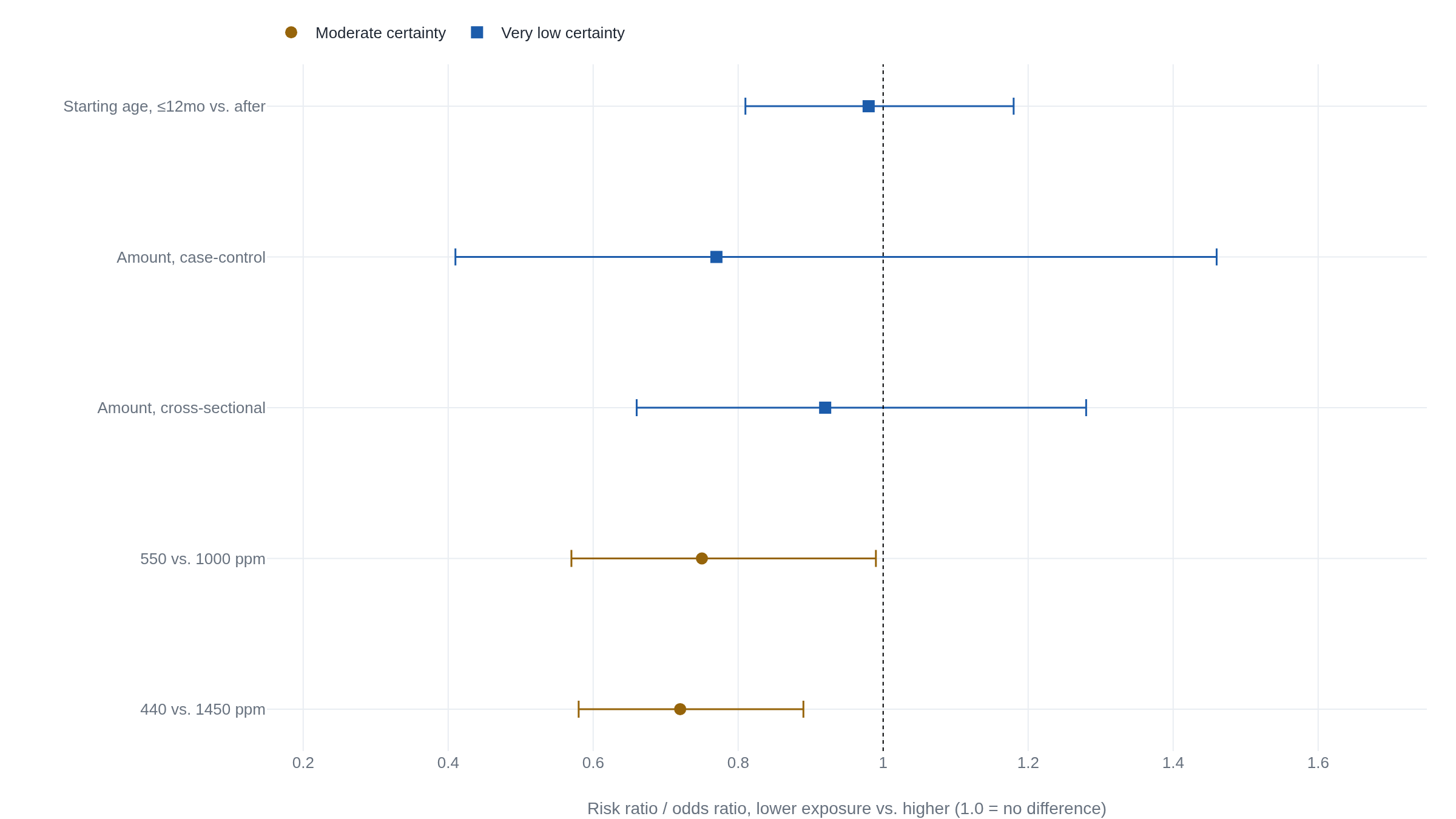
Whether starting brushing before or after a first birthday changes fluorosis risk is exactly the question a 2024 Cochrane review, led by Wong and colleagues, set out to settle, and it could not. Comparing children who began brushing at or before 12 months against those who began later, across two cohort studies totaling 260 children, it found a risk ratio of 0.98 (95% CI 0.81 to 1.18). Cochrane rated that very-low-certainty: not evidence of no effect, but evidence too thin to detect one either way.7 That null result cuts against an older, more-cited figure. Wright et al.’s 2014 JADA review found that starting after 12 to 14 months lowered fluorosis odds (OR 0.70, 95% CI 0.57 to 0.88), implying an earlier start raised the risk. It is the number still repeated in secondary write-ups of this question.8 The two reviews examined close to the same comparison a decade apart. The newer, narrower one found nothing. The older, more widely repeated one found a signal. Wright’s finding rests on a larger evidence base but was not built to isolate starting age the way Wong’s dedicated review was. Wong’s own analysis, in turn, is thin enough, 260 children, very-low certainty, that a null result cannot be read as proof no effect exists. Between the two, the more current, more targeted analysis is the better guide, even carrying less certainty.
The one fluorosis comparison in Wong’s review that did clear moderate certainty was concentration, not timing. Two single trials found that lower-strength toothpaste lowered fluorosis risk against higher-strength. 550 ppm against 1000 ppm gave a risk ratio of 0.75 (95% CI 0.57 to 0.99, 959 children). 440 ppm against 1450 ppm gave 0.72 (95% CI 0.58 to 0.89, 1,009 children).7 The amount of toothpaste used per brushing, like starting age, had only very-low-certainty evidence either way (case-control OR 0.77, cross-sectional OR 0.92).7 Of the three exposures Wong’s review examined, concentration is the only one with evidence solid enough to act on.
A water test decides whether a supplement is even on the table
The toothpaste decision does not depend on where a family lives. The supplement decision does. USPSTF frames the trigger as tap water below 0.6 ppm fluoride.2 The CDC’s own three-tier schedule, adopted in 1994 and reproduced identically in the AAP’s and ADA’s own guidance, is more particular. It gives no supplement at any water-fluoride level for an infant under six months. From six months to three years, it gives 0.25 mg a day only if the water is below 0.3 ppm, and nothing at all in the 0.3-to-0.6 ppm band that USPSTF’s own threshold would still flag.19 The two documents do not obviously specify the same rule for a household in that middle band. What both agree on is the floor: no supplement, at any water level, before six months.
| Age | <0.3 ppm F | 0.3–0.6 ppm F | ≥0.6 ppm F |
|---|---|---|---|
| Birth–6 mo | None | None | None |
| 6 mo–3 yr | 0.25 mg/day | None | None |
| 3–6 yr | 0.50 mg/day | 0.25 mg/day | None |
| 6–16 yr | 1.0 mg/day | 0.50 mg/day | None |
The schedule got smaller for a reason. In 1994, the ADA, the American Academy of Pediatric Dentistry and the AAP jointly cut the supplement doses to their current, lower levels “in response to accumulated data on fluoride intake and the prevalence of enamel fluorosis,” according to the CDC’s own account of the change.10 One study cited in that same CDC report shows why the water test comes first. Children given a fluoride supplement while already living in a fluoridated area had 23.74 times the odds of fluorosis of children who were not (95% CI 3.43 to 164.30).10 That is not this household’s situation if the water tests low. But it is exactly the failure mode the water-ppm branching exists to prevent. Testing the water before filling a fluoride-drop prescription is not a formality.
The FDA and the pediatric schedule now disagree
On October 31, 2025, the FDA announced its conclusion about ingestible fluoride prescription drugs, drops and tablets. They “should not be used in children under age 3 or by older children who are not at high risk of tooth decay,” the agency said.11 That is not a formal withdrawal of drug approval. The agency sent notices to four companies threatening “compliance action” unless they take “corrective actions,” the enforcement tool available to it, rather than pulling the products’ approval outright.11 FDA Commissioner Marty Makary said ingestible fluoride “is now recognized to alter the gut microbiome”; HHS Secretary Robert F. Kennedy Jr. called the action “driving a stake through the heart of outdated science.”11 The agency’s own cited concerns reach beyond fluorosis, to altered gut microbiome development, thyroid disorders, weight gain and lowered IQ.11
The dental profession disputes the framing without disputing the date. The ADA’s own response confirms the under-3, low-or-moderate-risk threshold and states that “a doctor’s clinical judgment, not a new warning label, should remain the guiding factor.”12 The California Dental Association adds a specific rebuttal to FDA’s evidence. The concentrations in the studies FDA cited were “more than double the recommended levels for community water fluoridation and fluoride supplementation,” the CDA says. Those same studies, in the CDA’s reading, “did not establish a link between fluoride exposure and negative health outcomes at levels used in community water fluoridation or fluoride supplementation.”13 Neither side has produced a fact that resolves the dispute outright. FDA’s action is real, current, and aimed at exactly the drug products a low-fluoride-water household might be prescribed. The professional pushback is also real, and it has not reversed the FDA’s action. As of this writing, the AAP/ADA/CDC schedule remains standing clinical guidance, and the FDA’s objection to using it in a child under three is also standing federal position. Both stand at once, and they point in opposite directions for the same six-month-old.
This dispute over drops is separate from the louder fight over adding fluoride to municipal water. Utah and Florida banned community water fluoridation in 2025. A 2024 federal court ruling separately ordered the EPA to reconsider its fluoride standard over similar concerns about children’s IQ, and more than 60 communities have ended or suspended fluoridation since.14 That is a question about the water supply generally, not about the drops a pediatrician might prescribe to one child, and it does not change anything about the water-test-and-schedule decision above.
The brushing amount is settled. The supplement is not.
The two gaps in this evidence are not the same kind of gap. The toothpaste and varnish guidance for a six-month-old rests on trials that started at one. The fluorosis-timing evidence, examined directly, found no clear effect of starting early either way, only a moderate-certainty effect from higher concentration.7 That is an evidentiary gap the safety data itself does not turn into a live worry: a low-concentration smear at the first tooth is exactly what the concentration evidence supports, the untested starting age notwithstanding. The supplement gap is not the same shape. It is not a hole in old trials. It is a live disagreement between a federal drug regulator and standing pediatric guidance, unresolved as of this writing.911
- A rice-grain smear of standard-strength fluoride toothpaste (about 0.25 mg) from the first tooth, brushed twice daily and supervised, is what every cited body agrees on, even though the exact starting age was never tested directly.15
- The dose-response evidence for decay prevention is high-certainty at 1000-1250 ppm, and slightly stronger still at 1450-1500 ppm.3
- The fluorosis lever a household actually controls is toothpaste concentration, not the calendar month brushing starts.7
- No trial has enrolled a six-month-old directly. “Start at the first tooth” is an extrapolation every cited body makes without saying so.134
- A fluoride supplement should not start before the household’s water is tested. Giving one on top of already-fluoridated water measurably raises fluorosis risk.10
- The FDA and the AAP/ADA/CDC schedule currently disagree on ingestible fluoride under three. A pediatrician or dentist should weigh that live conflict for this specific child, not a schedule alone.911
The toothpaste decision is settled enough to act on now: a rice-grain smear of standard-strength fluoride toothpaste from the first tooth, brushed and supervised, which is what the concentration evidence, not the untested starting age, actually supports.37 The supplement decision is not settled. Test the water, and bring the FDA’s October 2025 action to whichever clinician would otherwise write the prescription, because the standing schedule and the federal warning currently point opposite ways for a six-month-old in low-fluoride water.911
Sources
- American Academy of Pediatrics · Fluoride Use in Caries Prevention in the Primary Care Setting (2014)
- USPSTF · Prevention of Dental Caries in Children Younger Than Age 5 Years (2021)
- Cochrane Oral Health · Walsh et al., Fluoride Toothpastes of Different Concentrations for Preventing Dental Caries (2019)
- Cochrane Oral Health · Marinho et al., Fluoride Varnishes for Preventing Dental Caries in Children and Adolescents (2013)
- American Dental Association · Fluoride Toothpaste Use for Young Children (JADA, 2014)
- NCHS · Beltrán-Aguilar, Barker & Dye, Prevalence and Severity of Dental Fluorosis in the United States, 1999–2004 (Data Brief No. 53, 2010)
- Cochrane Oral Health · Wong et al., Timing, Amount and Concentration of Fluoride Toothpaste for Dental Fluorosis (2024)
- Centre for Reviews and Dissemination (DARE) · Critical abstract of Wright et al., Fluoride Toothpaste Efficacy and Safety in Children Younger Than 6 Years (JADA, 2014)
- American Dental Association · Evidence-Based Fluoride Supplement Chairside Guide
- CDC MMWR · Recommendations for Using Fluoride to Prevent and Control Dental Caries in the United States (2001;50(RR-14))
- HHS/FDA · FDA Acts to Protect Children From Unapproved Fluoride Drug Products (October 31, 2025)
- American Dental Association · Statement on Fluoride Supplements for Children 3 and Younger
- California Dental Association · FDA Acts to Limit Fluoride Supplements for Children
- Multistate · States Move to Ban Water Fluoridation: Utah and Florida Enacted Laws in 2025